Crafting a high-impact document requires more than listing your previous job titles; you must synthesize your professional history into a narrative that demonstrates immediate value to hiring managers. Whether you are a seasoned executive or a candidate drafting a resume with no experience, your application must bridge the gap between your unique past and the company's future objectives.
This guide breaks down the essential formats and tactical approaches needed to land your next role in modern automated hiring environments. Before selecting your layout, review what a resume is and how recruiters evaluate it, explore whether to use an AI resume builder vs writing a resume from scratch, and understand the 5 essential sections every resume must include.
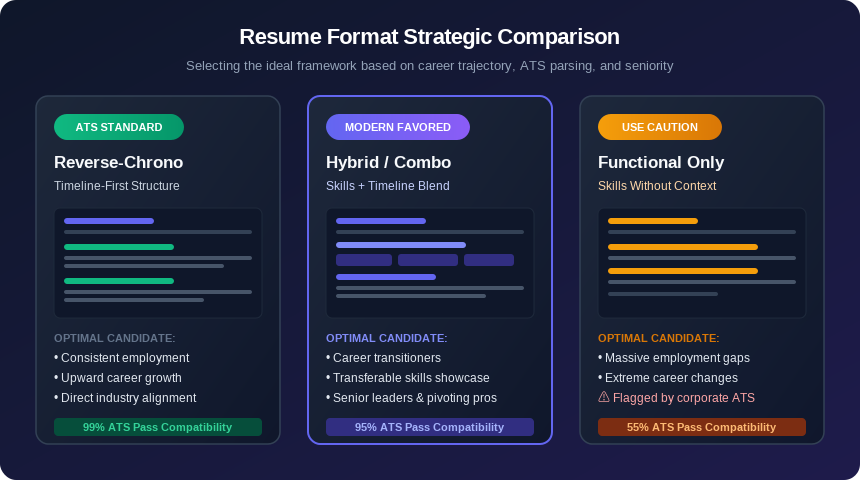
Analyzing the Hybrid Resume and Tips for a Resume No Experience
A hybrid resume integrates a chronological work history with a comprehensive functional skills section, providing a structure that highlights core competencies alongside your professional timeline. This format serves candidates who need to emphasize specific expertise while demonstrating a clear, consistent career progression, making it ideal for those pivoting industries, showcasing transferable abilities, or building a resume with no formal work history.
This structure provides a strategic advantage for individuals with disjointed work histories or those entering new sectors. For example, a graphic designer transitioning into UX research might prioritize "User Testing" and "Wireframing" skills above their previous freelance design projects. By highlighting these technical areas first, you lead the recruiter toward your greatest strengths before they analyze your chronological history. Senior professionals benefit from this format by emphasizing high-level leadership competencies that might otherwise be buried within specific job descriptions.
If you have a background in hospitality looking to move into corporate administration, use the skills section to highlight Vendor Management, Budget Reconciliation, and High-Volume Scheduling. By front-loading these proficiencies, you shift the recruiter's focus from your industry title to your functional value. This approach works well for those who have spent years in one industry but possess underlying skills that apply to entirely new professional environments, effectively rebranding your identity. When building a resume with no experience, this hybrid approach allows you to highlight academic projects as core competencies, effectively replacing the standard work history section. Read our complete guide on how to write a resume with no work experience for section-by-section examples. You can also explore our library of real-world resume examples to see how various formats look across different industries.
Drafting a Resume With No Experience
Drafting a resume with no experience requires shifting your focus from historical job titles to project-based accomplishments. By emphasizing academic research, volunteer contributions, and internships, you highlight your capacity to execute tasks and learn quickly. This narrative structure demonstrates your potential value to prospective employers, proving you possess the initiative to succeed from day one without needing traditional oversight.
Focus on the impact of your actions rather than the basic duties of a position. Learn how to transform daily responsibilities by crafting quantified resume bullets or reviewing our step-by-step guide on how to write a resume step by step:
- Weak phrasing: "Responsible for organizing school events."
- High-impact framing: "Coordinated logistics for a 200-person regional conference, increasing attendance by 15% through targeted social media outreach."
Expanding Your Reach Through Volunteering
Seek out high-impact volunteer roles to fill gaps. For instance, managing the social media accounts for a local non-profit functions as a legitimate marketing internship. Document your metrics, such as audience growth or engagement rates, just as a professional would. This provides tangible evidence of your performance in a real-world setting. If you helped a neighborhood association secure funding, treat that as a grant-writing or fundraising project. By treating volunteer roles with the same rigor as paid positions, you demonstrate professional habits, punctuality, and the ability to collaborate within a team structure, which are often the primary concerns hiring managers have regarding entry-level talent.Tailoring Your Resume for Target Industries
Every industry prioritizes different attributes. When applying for a role in finance, emphasize your technical proficiency with data modeling and regulatory knowledge. Conversely, when applying for a creative agency, showcase your portfolio and problem-solving process. Research the specific terminology used in job descriptions for your target field and mirror that vocabulary.By mapping your existing skills—gained through school or personal projects—to the needs of the employer, you demonstrate that you understand the work, even if you are new to the professional environment. A candidate for a data entry role should highlight "spreadsheet automation" and "data integrity," while a candidate for a customer service role should highlight "conflict resolution" and "CRM proficiency."
Adapting to AI Screening Standards
Applicant Tracking Systems serve as digital gatekeepers that scan documents for specific keywords and formatting cues before they reach a human reader. Aligning your file with these technical requirements optimizes your chances of passing automated filters and successfully reaching the interview stage, increasing your overall visibility among recruiters and hiring managers.
To discover the latest scanning benchmarks, read our guide on what makes a good resume in 2026. To remain compliant with these systems, use standard headings like "Experience" and "Skills" rather than creative labels. You can also test your current draft using our Free ATS Resume Checker. Avoid complex graphics, icons, or nested tables that often confuse text-parsing software, as these can lead to data loss during the upload process. Learn more in our breakdown of 15 common resume mistakes that cost you an interview. Prioritize clear, hierarchy-driven layouts that allow the system to categorize your career progression accurately. If you are a senior candidate, avoid over-optimizing with forced "keyword stuffing." AI systems now detect unnatural repetition, which can flag your application as spam. Instead, integrate core competencies into your bullet points naturally and contextually.
| Feature | ATS-Friendly Standard | Risk-Prone / Unsafe |
|---|---|---|
| Headers | Standard (Work Experience, Skills, Education) | Creative (My Journey, Where I've Been) |
| Graphics | Plain Text layers & semantic tags | Decorative icons, logos, floating images |
| File Type | Machine-readable PDF or .docx | Scanned image PDF, .jpeg, .png |
| Layout | Single-column linear flow | Multi-column, floating text boxes, canvas layers |
Addressing Non-Traditional Career Paths
Non-traditional career paths involve navigating employment gaps, extended freelance projects, or frequent sector shifts by reframing these experiences as continuous professional growth. By focusing on transferable skills and evidence-based development, you demonstrate that your unique background provides a fresh perspective and genuine value to a prospective team regardless of the timeline.
Consider a candidate who took two years off for personal care or family obligations. Rather than leaving a blank space, they might list "Sabbatical: Professional Development and Skill Acquisition," highlighting certifications or independent projects completed during that time. Freelancers should group various projects under a single "Consultant" title to show a consistent timeline of output, preventing the "job-hopper" label often incorrectly applied to contractors.
By focusing on the results achieved during these periods—such as mastering a new software or completing a certification—you maintain your professional momentum. Make sure to adhere to recommended page limits outlined in our resume length guide. If you want more tips on how to handle career pivots, explore our guide on how to choose the right AI resume builder for your career transition and map your path with our AI career roadmap.
Strengthening Your Outreach
Once your resume is polished, your outreach to recruiters needs to be precise. Use a direct, professional tone when following up on applications to show genuine enthusiasm:``text
Subject: Following up on Application - [Job Title] - [Your Name]
Dear [Hiring Manager Name],
I hope your week is off to a great start. I recently submitted my application for the [Job Title] position and wanted to reiterate my strong interest in the role. Given my background in [Specific Skill], I am confident I can contribute to your current goals. Please let me know if you require any additional information.
Best regards,
[Your Name]
``
Browse our vetted gallery of clean, ATS-compliant resume templates built for chronological and hybrid formats. Get started in minutes with AI-assisted bullet writing.