Choosing the correct resume length depends on your career trajectory, industry norms, and the depth of your achievements. While the traditional one-page constraint is a familiar benchmark, seasoned professionals frequently find that two pages provide the necessary space to document complex project outcomes without sacrificing clarity or visual layout.
The optimal resume length balances reader engagement with information density. Recruiters typically spend 6 to 7.4 seconds skimming a document during the initial intake phase, meaning length is secondary to the quality and positioning of your quantifiable impact statements. Understanding what a resume is and what recruiters look for helps ensure your high-value wins appear above the fold. By prioritizing high-value data over legacy roles, you deliver a concise narrative that highlights your direct suitability for your target position.
Understanding Resume Length Requirements
Resume length refers to the physical page count of your application, usually spanning one to two pages for standard corporate and tech roles. This metric dictates your available space to articulate qualifications, balancing brevity with the display of professional substance. Defining this length requires a strategic assessment of your career timeline against role demands.
For most job seekers, the primary goal minimizes cognitive load on the hiring manager. A three-page document often looks cluttered, causing human screeners to overlook critical information. Conversely, a resume that is too short may leave gaps that prompt skepticism regarding your career progression or depth of skill.
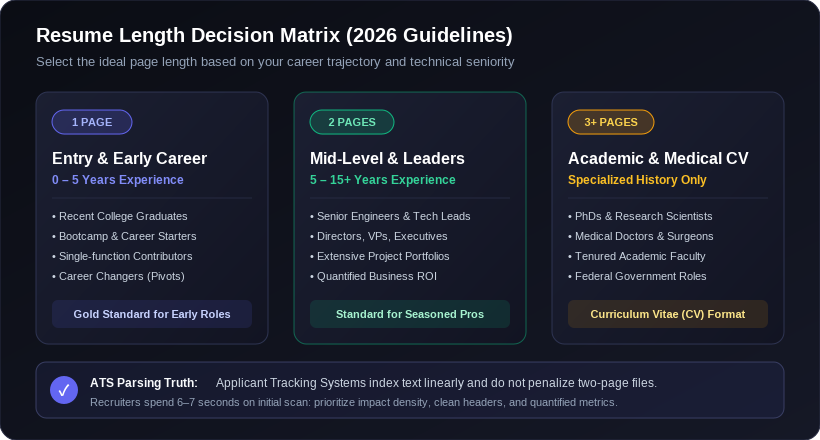
| Career Stage | Recommended Length | Strategy Focus |
|---|---|---|
| Entry-Level & Grads | 1 Page | Academic coursework, projects, technical skills, internships (see our guide on writing a resume with no work experience) |
| Mid-Career (3–8 Yrs) | 1 – 2 Pages | Measurable achievements, specialized tool stacks, promotions |
| Senior & Executive (8+ Yrs) | 2 Pages | Strategic leadership, cross-functional ROI, team scale, budget |
| Academic & Medical | 3+ Pages (CV) | Publications, clinical trials, grants, peer-reviewed research |
Parsing Length Through ATS Technology
Applicant Tracking System (ATS) parsing technology involves automated algorithms that scan your uploaded document to extract and categorize metadata like job titles, tenure, and technical competencies. These systems prioritize clean, single-column formatting over document length, meaning a well-structured two-page file is processed just as effectively as a one-page document by modern hiring software like Greenhouse, Workday, Lever, and Taleo.
Systems like Greenhouse or Taleo prioritize tokenization to match your background with job descriptions. If you use non-standard graphics, icons, or complex tables, you trigger parsing errors. Save your resume as a machine-readable PDF or DOCX file using standard text. A candidate who uses a custom-coded "skills map" infographic often finds their technical proficiencies ignored. In contrast, a candidate using a clean, structured bulleted list allows the software to index every tool correctly, increasing the likelihood of passing the initial digital screen. If you suspect your layout is overly complex, browse our ATS-Friendly Resume Templates to ensure effortless parsing.
Because ATS software functions by reading left-to-right and top-to-bottom across continuous text streams, longer documents do not inherently confuse the algorithm. However, issues arise when candidates attempt to "game" length by cramming keywords into white space or using hidden text. These deceptive tactics often flag your profile as spam. If you have a decade of experience, do not fear that a second page will cause the ATS to reject you; the software evaluates the frequency and context of your skills rather than total page count. You can test your file right now on our Free ATS Resume Checker to verify your parsing score.
Debunking Common Resume Length Myths
Myths regarding resume length often stem from outdated career advice that fails to account for modern hiring practices and digital screening tools:
- Myth 1: "Recruiters throw away any resume longer than 1 page."
- Myth 2: "White space is wasted real estate."
- Myth 3: "ATS software automatically cuts off page two."
By focusing on content density over arbitrary page constraints, you present a polished, authoritative profile that stands out in competitive hiring pipelines. For modern standards on document structure, explore what makes a good resume in 2026, and read our deep-dive guide on What Information to Put on a Resume in 2026.
Strategies for Condensing Content
Condensing content is the systematic process of pruning superfluous details to improve the impact density of your professional narrative. By removing dated information and focusing on quantifiable results, you transform a bloated document into a punchy, persuasive marketing tool that commands attention from time-strapped hiring managers seeking proof of competence.
When auditing your document for space, implement these high-leverage adjustments:
- De-prioritize ancient history: If you have over ten years of experience, compress roles from early in your career into a brief "Early Career History" note listing company, title, and years without bullet points.
- Remove redundant skills: Avoid listing basic software like Microsoft Word or web browsing. Replace them with high-signal technical stacks, such as AWS, Docker, React, or SQL.
- Audit your header: Keep contact details concise (Name, City/State, Phone, Email, LinkedIn/Portfolio). Full street addresses are obsolete.
- Use tight power verbs: Replace passive phrases like "Responsible for the management of the team" with active impact statements like "Led cross-functional engineering squad of 12."
💡 The Rule of Three for Older Positions:
For roles held more than five years ago, limit yourself to the three most significant achievements. This demonstrates career growth without consuming prime space that belongs to your latest leadership milestones.
If you struggle to fit your experience onto the desired page count, perform a line-by-line audit on your bullet points. Junior candidates frequently write 4 lines describing mundane tasks. By trimming each bullet to 1–2 lines focusing strictly on Outcome + Action + Metric, you immediately cut 40% of document height while drastically increasing candidate appeal. Master this by writing high-impact resume bullet points using the Google XYZ formula, explore our tutorial on writing resume bullet points step by step, or see them modeled across real role-specific resume examples.
Managing White Space and Formatting
Proper white space usage keeps your resume legible and visually inviting. If your document feels cramped, adjust your margins to 0.5 inches or 0.75 inches, but avoid going narrower as it crowds printable margins and causes reader eye fatigue:
- Font Sizing: Maintain 10pt to 11.5pt for body text and 14pt to 16pt for section headers. Never reduce body text below 9.5pt simply to force content onto one page.
- Visual Breathing Room: Ensure consistent paragraph spacing (4pt to 6pt after bullet points).
- Avoid Walls of Text: Dense paragraphs of text longer than 3 lines are routinely skipped by recruiters conducting 6-second scans.
Addressing Edge Cases and Non-Traditional Backgrounds
Edge cases represent unique professional circumstances—such as career gaps, freelance portfolios, or industry pivots—that require thoughtful space allocation:
- Freelancers & Consultants: Group contract engagements by project theme or client industry rather than itemizing dozens of individual gigs. This highlights domain expertise while preserving page space.
- Bootcamp Grads & Career Pivoters: Place your technical projects and certifications near the top. Use the first page to detail comprehensive capstone applications, which serve as direct proof of coding proficiency.
- Employment Gaps: Utilize a hybrid or combination resume format. This structure leads with functional skill clusters and quantifiable wins, keeping the reader focused on your problem-solving capabilities rather than calendar gaps. Compare your options in our analysis of the best resume format for your background, and evaluate formatting differences in our comparison of free resume builder vs making a resume manually.
Balancing Impact and Keyword Optimization
Keyword optimization aligns your document with the specific requirements listed in the employer's job description. You should weave industry-standard terminology organically into your bullet points:
- Avoid Keyword Stuffing: Repeating a skill 10 times in a row triggers ATS spam flags. Semantic NLP models recognize context and synonyms.
- Demonstrate Skills in Action: Instead of listing "Project Management" in isolation, demonstrate it: "Directed $1.2M ERP migration across 4 departments, delivering project 3 weeks ahead of schedule."
- Align Compensation Expectations: Compare your listed skills against industry benchmarks using our Tech Salary Benchmark Tool to ensure your job titles reflect market standards.
Video Guide: How Long Should Your Resume Be?
Frequently Asked Questions
Can I submit a three-page resume if I have a long career?
Outside of academic CVs, medical roles, or specialized research positions, a three-page resume is generally discouraged. Most recruiters stop reading before they reach the third page, as it often indicates a lack of ability to edit for clarity and conciseness.Does having a two-page resume hurt my chances with ATS software?
No, modern ATS tools do not rank candidates based on page count. The ranking is determined by your match to the job description keywords and contextual relevance, provided the formatting remains machine-readable plain text.How many years of experience justify a two-page resume?
You should move to two pages once you have crossed the 5 to 10-year threshold or have held three or more senior-level positions that require detailed metric descriptions to validate your business impact.Should my entry-level resume strictly be one page?
A one-page limit is strongly recommended for entry-level candidates, students, and new grads. At this stage, your professional history is rarely vast enough to justify more than one page, and excessive length can make you appear unfocused.Will smaller fonts help me fit more onto a single page?
While adjusting font size can help balance spacing, never reduce body text below 10pt or page margins below 0.5 inches. Unreadable tiny font frustrates recruiters reading on laptop screens and mobile devices.Whether you need a punchy 1-page resume or a detailed 2-page executive profile, our AI Resume Builder ensures your layout is 100% ATS-compliant and optimized for maximum recruiter impact.