A resume is a targeted marketing document that summarizes your career trajectory, technical abilities, and unique value propositions. Its primary function is to serve as a high-level bridge between your history and a recruiter’s needs, specifically designed to secure an interview rather than to function as an exhaustive biography.
What Exactly Is a Resume?
A resume is a concise summary of your employment history, educational background, and skill sets intended to pique the interest of hiring managers. It acts as a curated highlight reel that showcases your ability to solve specific business problems rather than simply functioning as a chronological record of tasks performed.
Moving away from the legacy "list of duties" model remains vital for modern applicants. Recruiters prioritize quantified achievements over static responsibilities. Learn our exact formula in our guide on how to write resume bullet points that show impact. A weak entry looks like: "Responsible for managing a team." A strong, results-driven entry reads: "Increased quarterly department output by 22% through the implementation of agile workflows." This shift from process-oriented descriptions to results-driven data helps you stand out. Consider your document a persuasive sales brochure for your labor, emphasizing the value you generate rather than the time you have spent in previous seats.
Why Do You Need a Resume?
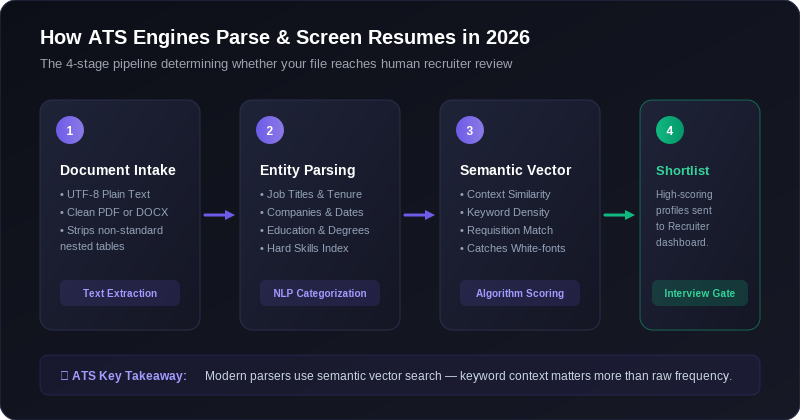
A resume functions as the critical gatekeeper between your talent and a company’s internal hiring workflow, including Applicant Tracking Systems (ATS) like Workday or Greenhouse. It is the primary data source that facilitates an initial semantic screening, determining whether your qualifications warrant a human review by a talent acquisition lead.
The 7-second rule highlights the reality of candidate screening. Recruiters perform a rapid visual scan to extract data points like job titles, tenure, and high-impact keywords. If your document uses complex graphics, non-standard fonts, or nested tables, an ATS may fail to parse your data, leading to a "ghosting" scenario where your credentials are never read. Discover how to avoid these traps in our guide to 15 common resume mistakes that cost you interviews. Furthermore, your resume acts as the foundational blueprint for your professional brand, matching the narrative found on your LinkedIn profile. Inconsistency between these digital touchpoints often raises flags regarding your attention to detail.
What Information Should You Include?
Standard resume sections provide a structured framework that allows AI-powered parsing engines to accurately index your data. While basic contact details and employment history are universal, high-impact documents incorporate modern sections such as technical certifications, hyper-linked project portfolios, and language proficiencies to demonstrate versatile, adaptable skill sets.
- Header: Include your name, city/state, phone number, and a
name@example.comaddress. - Professional Summary: Use a three-sentence pitch covering your domain expertise and core business impact.
- Experience: List roles in reverse-chronological order, focusing on bullet points that describe specific outcomes.
- Skills: Differentiate between hard technical skills—like SQL or Python—and broad industry competencies.
- Education: Keep this brief if you have more than three years of experience, prioritizing degrees and specific certifications.
Resume vs. CV: What’s the Difference?
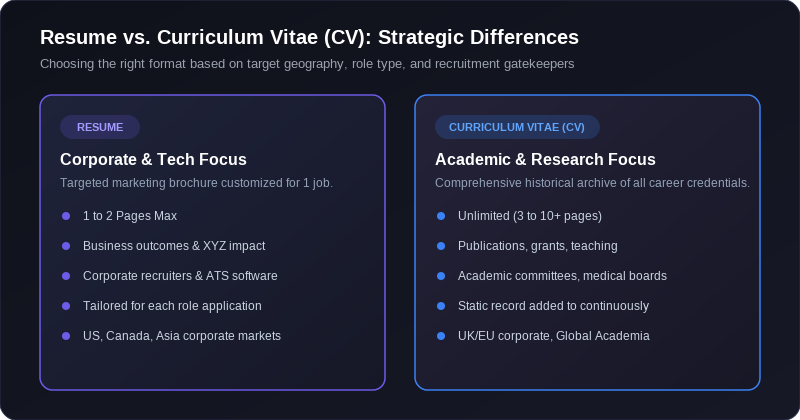
A resume is a brief, 1-2 page document emphasizing specific accomplishments and skills, while a Curriculum Vitae (CV) is an exhaustive, document-length account of your academic and professional history. Resumes are the standard for corporate roles globally, whereas CVs are typically requested for scientific, academic, or high-level international medical placements.
| Feature | Resume | Curriculum Vitae (CV) |
|---|---|---|
| Typical Length | 1–2 pages | Unlimited (often 3+) |
| Primary Focus | Skills and achievements | Academic and research history |
| Geographic Usage | North America, parts of Asia | Europe, Middle East, Academia |
| Updates | Frequent (job-specific) | Rare (career-wide) |
| Primary Goal | Getting an interview | Comprehensive data disclosure |
How to Build a Modern Resume
Building a modern resume requires a balance between human readability and machine-readable optimization, utilizing clean typography and clear headings to facilitate quick parsing. You must leverage semantic keyword positioning—placing your most critical certifications and industry-standard technical tools in the top third of the document to capture immediate attention.
Avoid "keyword stuffing," a tactic where applicants list dozens of terms in white text to trick an ATS. AI-driven screening now uses vector similarity to understand context; the system looks for the relationship between the tool and your application of that tool. If you claim proficiency in Kubernetes, your experience section must show where you deployed it. By using standard formats, such as a clean, text-based PDF or UTF-8 encoded file, you optimize your chances of passing through sophisticated parsing layers. To understand how automated systems process your background, learn what is an AI resume builder, read our analysis of what makes a good resume in 2026, and explore our tested ATS-Friendly Resume Templates to start with a verified layout.
Video Guide: Resume vs. CV Explained
Frequently Asked Questions
How does a CV differ from a resume?
A resume is a customizable marketing document for corporate job seekers, usually limited to two pages. A CV is a comprehensive, static record of your academic or scientific history used primarily for research or teaching roles where full historical documentation is required.What are the common resume formats I can use?
The three primary types are chronological, which lists work history in date order; functional, which organizes content by skill sets rather than timelines; and hybrid, which merges both structures to highlight specific achievements alongside a standard employment history.What is the ideal resume length?
Unless you are a senior executive or an academic with extensive research publications, a resume should be one to two pages. Modern trends favor extreme brevity; recruiters value clarity and high-impact, actionable data over long-form descriptions of past daily routines.How do ATS platforms scan my file?
An ATS is software that screens and sorts applications. It uses Optical Character Recognition (OCR) and semantic parsing to extract your skills and employment history into a database, looking for contextual connections between your content and the job description requirements.Which resume section matters most?
The "Professional Summary" and your most recent employment experience are the most vital segments. These areas occupy the "golden triangle" of eye-tracking patterns, serving as the first points of interaction for both AI screening tools and human recruiters making a quick decision to proceed.Our tools are built to help you navigate the 2026 hiring landscape with precision. Start crafting your high-conversion document today with our AI Resume Builder to pass the screen and secure your next interview.