To secure an interview, replace static task lists with dynamic resume bullet points that quantify your professional value. By using the Action-Result model, you translate daily activities into tangible achievements, proving to recruiters that you possess the skills necessary to deliver high-level organizational success. Avoiding common resume mistakes is the first step toward getting your profile noticed. Before fine-tuning your bullet points, review what a resume is and why it matters to modern recruiters.
Understanding Resume Bullet Points and Avoiding Mistakes
Resume bullet points are concise, impact-oriented statements that document professional achievements using active language. When crafted effectively, these lines function as the primary data points for ATS algorithms and human recruiters, providing evidence of your capability to solve complex business challenges. Focusing on outcomes over responsibilities prevents the most frequent resume mistakes, such as listing job descriptions that fail to highlight your personal contributions to company growth. If you are experimenting with generative prompts, evaluate should you use an AI resume builder? to understand how to guide language models effectively, and make sure your bullets align with the 5 essential resume sections needed for ATS compliance.
Many applicants suffer from the "job description trap," where they copy-paste duties directly from an HR handbook. To break this cycle, audit every line on your document. If a bullet describes what you were supposed to do, rewrite it to describe what you achieved.
- Weak: Managed internal communications.
- Strong: Orchestrated a global internal newsletter, improving employee engagement scores by 15% across four regional offices.
Mastering the Google XYZ Formula
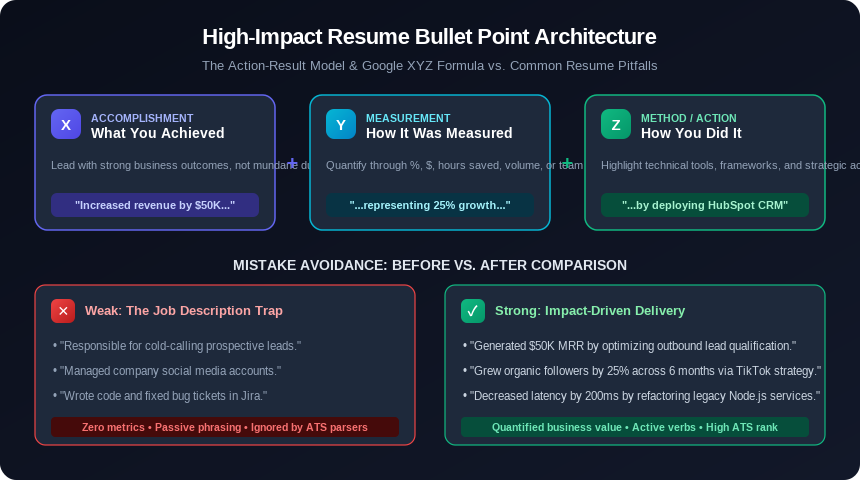
The Google XYZ formula is a structured writing framework that defines your contribution by stating: "Accomplished [X] as measured by [Y], by doing [Z]." This technique ensures your career narrative remains objective, data-backed, and optimized for both human readability and the specific keyword requirements of advanced applicant tracking systems.
While many experts emphasize results, the "Z" component—the how—is where you demonstrate critical thinking. If you are a student or candidate with limited work history, review our guide on writing a resume with no work experience to see how to focus on the methodologies and capstones you applied to reach your goals.
- Weak: Increased sales.
- Strong: Increased quarterly sales by 20% by implementing a new CRM segmentation strategy using Salesforce.
To further apply this, if you are in a leadership role, consider this framework: "Scaled team output [X] by 35% [Y] through the implementation of agile project management methodologies and CI/CD pipelines [Z]." This structure proves that your results were intentional and repeatable.
Common Resume Mistakes in Layout and Design
Design mistakes often sabotage the best content by making a document difficult for human eyes to parse. See our full audit of 15 common resume mistakes that cost you an interview for layout and typography pitfalls. Crowded margins, tiny fonts, and the misuse of decorative graphics create visual fatigue, causing recruiters to abandon your application. A clean, professional layout signals organizational skills and allows your strongest bullet points to stand out prominently.
When organizing your layout, learn about choosing the best resume format for your career stage, and explore our library of pre-formatted ATS-friendly resume templates. Also check our comprehensive guide on how long a resume should be to ensure your bullet density does not trigger awkward multi-page spillovers.
Avoid using multiple columns if the layout is not strictly linear, as many older parsing systems scramble text when columns are present. Stick to a standard font like Arial or Calibri at 10-12pt size. If you include contact information, ensure it is clearly placed at the top and avoid embedding it within an image, as this renders your name and email unsearchable by internal database software.
Tailoring Bullet Points to Job Descriptions
Tailoring bullet points involves mapping your historical professional achievements directly to the specific requirements and language found in a target job description. By mirroring the company’s stated needs through your accomplishments, you demonstrate immediate alignment, convincing hiring managers that your background provides a perfect solution to their current organizational pain points and strategic goals.
Blindly applying to positions with a one-size-fits-all resume rarely yields results. Instead, analyze the job posting for recurring themes, such as "team leadership," "budget management," or "process automation." If a posting emphasizes "cross-functional collaboration," do not just list your past teams; detail how you bridged communication gaps.
- Example: If the job description asks for "stakeholder management," rewrite a bullet from "Led software updates" to "Collaborated with cross-functional product, engineering, and sales stakeholders to deploy software updates, resulting in a 15% faster release cycle and total alignment on feature priorities."
Quantifying Results Without Hard Metrics
Quantifying results refers to the process of assigning precise scope, scale, or frequency to professional achievements when revenue figures are unavailable. By estimating impact through time savings, stakeholder volume, or percentage-based improvements, you provide the context needed to make your contributions appear significant, verifiable, and impressive to busy hiring managers.
Service-oriented roles often struggle with this, but impact is not always monetary. If you worked in administrative support, count how many individuals you supported or how many documents you processed. You can frame these as: "Streamlined faculty documentation processes for a department of 40 staff, resulting in a 20% reduction in weekly administrative overhead." Even if your metrics are based on reasonable approximations, providing a specific number remains far more persuasive than vague qualitative statements. A receptionist, for example, could write: "Managed high-volume front desk operations for a facility with 200+ daily visitors, reducing guest wait times by 10 minutes through a new digital check-in system."
Optimizing for ATS Parsing Systems
ATS parsing is the automated digital process by which applicant tracking software scans, extracts, and organizes your resume data. Correct formatting, such as standard bullet points and machine-readable text, allows these systems to accurately index your skills and experiences, preventing your application from being filtered out by poor structural design or non-standard characters.
To understand modern screening algorithms, review our breakdown on what makes a good resume in 2026. If your document uses non-standard symbols or complex vector graphics for bullet points, the parser may fail to interpret your text, resulting in a "null" entry for your work history. Use standard circular or square bullets and save your file as a machine-readable PDF or DOCX. Furthermore, avoid placing critical information in headers or footers, as many parsing algorithms ignore these zones entirely. Before applying, run your document through our Free ATS Resume Checker to verify keyword density and formatting compatibility.
Handling Non-Traditional Career Histories
Non-traditional career histories involve presenting gaps or pivots by emphasizing transferable competencies over chronological progression. Utilizing functional bullet points highlights core skills and specific project results that remain valuable regardless of the industry. Reframing these periods through specific achievements rather than leaving them unexplained prevents common resume mistakes and narrative fragmentation, providing a cohesive story.
For freelance contractors, avoid listing individual clients if it obscures your overall contribution. Group your projects by theme, such as "Product Development" or "Client Acquisition," and use bullets to detail the scope of your work. If you managed a community initiative during a career gap, treat it as a formal professional role: "Spearheaded a neighborhood outreach program, coordinating 15 volunteers and securing $5,000 in local funding, which demonstrated effective stakeholder management and budgetary oversight." Similarly, a parent returning to the workforce might highlight management skills: "Directed logistical planning and budget allocation for a non-profit organization with a $10,000 annual operating budget, improving resource distribution by 20%."
When addressing long-term employment gaps, use the "Career Note" method—a single line entry that explains the focus of your time, such as "Professional Development: Completed three industry certifications in Data Analytics and Cloud Computing." This approach maintains the professional tone of your document while accounting for your time off in a way that aligns with your future career goals. Once your resume opens doors, prepare for behavioral interviews with our AI mock interview practice tool.
Impact Comparison Table
| Feature / Domain | Weak (Task-Oriented) | Strong (Impact-Oriented) |
|---|---|---|
| Sales | Cold-called prospective clients. | Generated $50k in new monthly recurring revenue by optimizing outbound lead qualification. |
| HR / People Operations | Maintained employee files. | Reduced file audit time by 30% by transitioning records to a cloud-based digital database. |
| Education & Training | Taught biology classes. | Facilitated core science curricula for 150+ students, achieving a 95% final exam pass rate. |
| Tech & Engineering | Wrote backend code. | Refactored legacy codebases, decreasing system latency by 200ms and improving UI response time. |
Video Guide: 5 Resume Mistakes You MUST Avoid
Frequently Asked Questions
How many bullet points should I put under each job?
Aim for three to six bullet points per role. This allows enough space to show impact without overwhelming the reader. If a position was brief, stick to three; for senior roles with long tenures, six is appropriate to demonstrate the evolution of your responsibilities.What are the best action verbs to use?
Select verbs that imply leadership and transformation. Words like Spearheaded, Orchestrated, Quantified, Architected, Negotiated, and Transformed carry more weight than generic terms like Helped or Managed. Match the verb to the level of seniority expected for the specific job description.Should I put periods at the end of my bullet points?
Consistency is the priority. If your bullet points are full sentences, use a period at the end of every line. If your bullets are sentence fragments, avoid punctuation. Most recruiters prefer brief, punchy fragments, but clear, grammatical sentences are better for conveying complex technical impacts.Will the ATS struggle with my bullet points?
Most systems handle standard round bullets seamlessly. Avoid using custom icons, emojis, or complex text boxes, as these can trigger OCR parsing errors. If you are uncertain about your layout, verify your document through our Free ATS Resume Checker to ensure clean text extraction.How far back should my resume go?
Keep your professional history to the last 10–15 years. Recruiters are primarily interested in your recent trajectory and the skills you currently possess. If you have older, high-impact roles, include them in an "Earlier Career Experience" section with fewer bullet points to keep the focus on your current value.Transform your daily duties into quantifiable, ATS-friendly bullet points with CareerNest's intelligent resume builder.