If your applications result in silence, your resume mistakes are likely triggering an automatic rejection by ATS algorithms or human recruiters. You have roughly six seconds to prove your value before a screener moves on. To secure an interview, replace generic templates with a skill-centric, quantifiable narrative that highlights specific professional outcomes. Before diagnosing your draft, review what a resume is and why it matters to modern talent acquisition teams.
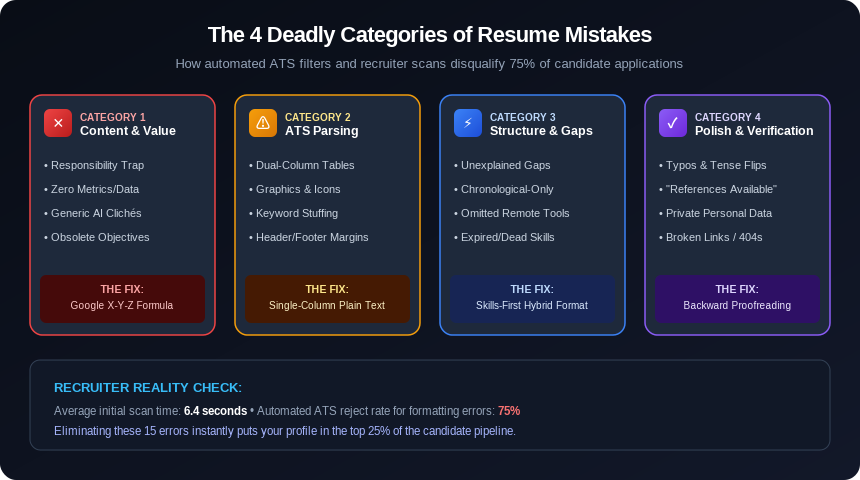
1. The "Responsibility" Trap
This error involves listing static job duties rather than demonstrating unique value through concrete accomplishments. By focusing on what you were tasked to do instead of what you actually delivered, you fail to differentiate yourself from other candidates. Shift your phrasing to focus on impact and measurable contributions to the team. Learn how to transform static tasks into proven achievements in our guide on how to write resume bullet points that show impact.
- Weak: Managed social media accounts and posted updates.
- Strong: Drove a 25% increase in organic engagement by implementing a new video-first content strategy across TikTok and LinkedIn.
2. Neglecting ATS Keyword Optimization
Applicant Tracking Systems act as digital gatekeepers, using parsing software to score your document against job descriptions. If your resume lacks the specific nouns, software titles, and industry jargon required for a role, your profile never reaches a human. Use standard headings and plain text to preserve your document’s readability. To verify that your keywords match target roles, test your draft with our Free ATS Resume Checker and review what makes a good resume in 2026.
3. Excessive Design and Formatting Bloat
Over-engineered resumes featuring progress bars, custom icons, or dual-column layouts often confuse OCR parsing tools. These elements disrupt the data extraction process, causing your skills and work history to appear jumbled or missing. Understand the differences between tools and manual formats in our guide on free resume builder vs making a resume manually. Keep your document in a clean PDF or DOCX format to preserve structure and accurate data interpretation. Explore pre-vetted ATS-friendly resume templates that guarantee 100% parse rates without sacrificing aesthetic appeal.
4. Generic AI-Generated Summaries
Over-relying on LLMs produces robotic, hollow summaries that lack a human voice or specific context. Recruiters can instantly identify "LLM-bloat" when they see overused buzzwords like "passionate," "synergistic," or "dynamic leader." Instead, curate a summary that bridges your experience with the company's specific mission using your own terminology. Ensure your header and summary align with the 5 essential resume sections.
5. Failure to Highlight Remote-Ready Competencies
Many candidates omit their ability to function in asynchronous environments, which is a major oversight for modern hybrid or remote roles. Proving your proficiency in tools like Slack, Notion, Asana, or Jira is essential. Demonstrating how you managed remote workflows signals that you require minimal onboarding for virtual environments.
Comparison: Weak vs. Strong Bullet Points
| Domain / Function | Weak Bullet (Duty-Based) | Strong Bullet (Outcome-Based) |
|---|---|---|
| Sales | Managed a regional sales territory. | Exceeded regional targets by 15% ($200k) over two years by implementing proactive account renewals. |
| Tech Support | Handled customer support tickets. | Reduced average ticket resolution time by 30% via automated triage, maintaining a 96% CSAT score. |
| Management | Supervised a team of junior designers. | Mentored 5 junior designers to promotion by implementing a structured bi-weekly peer-review system. |
6. Including Extraneous Personal Identifiers
Candidates frequently clutter their header with full street addresses, age, or marital status, which introduces bias and takes up valuable space. Your contact section should only include your name, a professional phone number, city, and a clean link to your LinkedIn profile. Avoid unprofessional addresses like hustler99@email.com and use firstname.lastname@email.com instead.
7. The Chronological-Only Fallacy
Relying solely on a chronological format can disadvantage applicants with career gaps or those pivoting industries. A "Skills-First" approach allows you to categorize your expertise by core competencies before diving into your employment history. This highlights your specific capabilities immediately, rather than forcing the reader to hunt for them across job titles. Compare all structural architectures in our guide on choosing the best resume format, or check out our tutorial for writing a resume with no work experience.
8. Failing to Proofread for Grammar
A single typo, inconsistent date format, or incorrect punctuation is a primary cause for immediate disqualification. When your resume contains errors, it suggests a lack of attention to detail and a disregard for quality. Read your document backward to catch hidden typos, and check that every bullet point uses consistent verb tenses (past tense for previous roles, present tense for your current position).
9. Over-Tailoring with Keyword Stuffing
While alignment is necessary, stuffing your document with hidden white-font text or excessive tags will result in a penalty. Recruiters can easily spot unnatural keyword clusters that do not flow with the rest of your text. Embed your skills naturally within the context of your previous accomplishments to satisfy both algorithms and human readers. Benchmark your tailored content against real role-specific resume examples to see proven keyword distribution across top industries.
10. The Employment Gap Blind Spot
Leaving large, unexplained gaps in your work history forces recruiters to speculate about your productivity. Address these periods transparently by framing them as opportunities for skill acquisition or project work. If you took time off for personal development, list the certification or independent project you completed during that interval to maintain your narrative. Read our guide on how to choose the right AI resume builder for your career transition to see how modern builders reframe employment gaps into actionable strengths.
11. Including "References Available"
Stating "References available upon request" is a redundant holdover from the pre-digital era. It consumes space that could be used to elaborate on your technical stack or project successes. If a company requires references, they will reach out to you once they reach the final stages of the interview process.
12. Using Obsolete Objective Statements
Objective statements focus on what you want from the employer, rather than what you bring to the table. In a modern hiring context, this phrasing feels selfish and outdated. Replace it with a value-driven summary that highlights your years of expertise and the primary solutions you offer to current industry challenges.
13. Poorly Managed Links
Broken or dead links to your portfolio, GitHub, or LinkedIn profile reflect poorly on your digital literacy. Always check your live document in a PDF viewer to confirm that your hyperlinks open correctly. If you are linking to a long, messy URL, use a professional URL shortener or hyperlink the text directly.
14. Listing Expired or Irrelevant Skills
Including software or methodologies that have been obsolete for a decade distracts from your modern capabilities. Your skills section should be a dynamic list that changes based on the job description. Remove legacy tools that no longer align with current industry standards unless they are explicitly requested by the hiring manager. To build an ATS-aligned skills taxonomy, read our guide on how to optimize your resume skills using an AI resume builder.
15. Lack of Quantifiable Metrics
Vague statements about your performance leave the recruiter unable to gauge your actual contribution. You must include specific data points, such as dollar amounts, percentage growth, time saved, or the scale of the team you managed. Without these numbers, your accomplishments are merely subjective claims that carry little weight in the final selection. Learn the step-by-step formula in our tutorial on how to write resume bullet points step by step. Also review our guidelines on how long a resume should be to balance detail with white space.
Once you fix these 15 errors and begin receiving recruiter interview invitations, prepare for live behavioral questions using our AI mock interview practice coach.
Video Guide: Top Mistakes to Avoid on Your Resume
Frequently Asked Questions
How long should my resume be?
Aim for one page if you have less than 10 years of experience. Professionals with extensive, high-level leadership histories may extend to two pages, provided every line contributes unique, high-value information. Read our full analysis on how long a resume should be.Should I include a photo on my resume?
No. In the US, UK, and most tech markets, photos can trigger unconscious bias and are often stripped by ATS software. Stick to clean text-based credentials.What is the most common resume error?
The biggest error is failing to quantify achievements. Recruiters prioritize candidates who demonstrate clear, measurable impact over those who simply list daily duties. Use our guide on how to write resume bullet points that show impact to format every achievement.Do I still need an objective statement?
No. Replace it with a 3-to-4 sentence "Professional Summary." This provides a compelling snapshot of your experience and value proposition, which is far more persuasive than stating personal career goals.How do I explain gaps in my work history?
Frame gaps as productive periods. If you spent time on professional development, freelancing, or personal projects, list these as entries in your work history to show you remained engaged in your field. Explore our guide on writing a resume with no work experience for formatting ideas.Don't let these preventable errors keep you from your next opportunity. Our AI Resume Builder helps you craft a high-impact, ATS-optimized document tailored to your specific industry.