Writing a resume for 2026 involves moving away from static duty lists toward a dynamic narrative. Your goal is to bridge the gap between automated parsing software and the human decision-makers who evaluate your candidacy. Understanding the core purpose of a resume and having the 5 essential resume sections in place ensures your document hits the right structural benchmarks. By utilizing clean formatting and data-driven achievements, you create a document that demonstrates tangible business impact.
The Technical Foundations of ATS Parsing
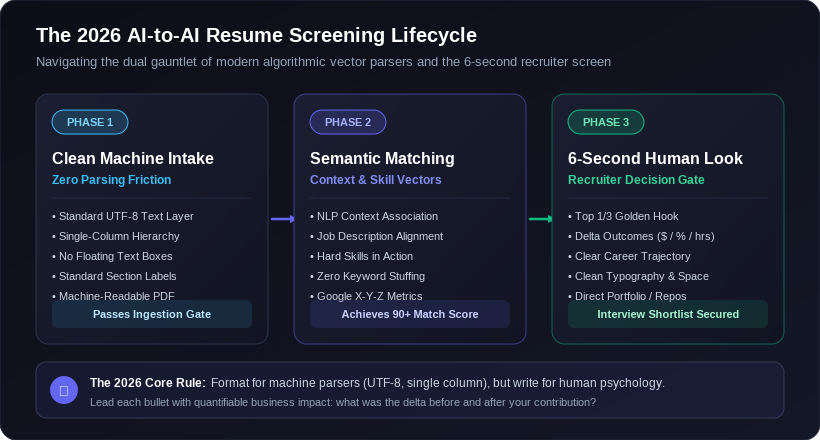
Applicant Tracking System (ATS) parsing is the automated digital indexing of candidate data into a searchable database. This process transforms your document into structured information, enabling recruiters to query specific requirements. To navigate this system, use simple, machine-readable text layers rather than design-heavy graphics, complex tables, or non-standard fonts.
Simplicity acts as the gold standard for digital compatibility. When you choose a clean, text-based PDF, you allow algorithms to index your history without obstruction. For instance, a junior developer might mistakenly use a multi-column template filled with heavy graphics. This often results in the software misreading the "Education" section as part of the "Experience" section, causing critical data loss.
By contrast, a senior engineer uses a linear, chronological layout. This enables the system to correctly parse "Senior Software Engineer" as a job title rather than a project category, keeping their profile visible to the hiring team throughout the initial filtering stages. When deciding whether to use automation, evaluate should you use an AI resume builder? to see where tools excel and where human voice is needed. For layouts pre-verified against automated parser standards, choose from our tested ATS-Friendly Resume Templates.
Designing for the Six-Second Human Review
The six-second review is the rapid, intuitive visual scan a recruiter performs to determine if a candidate’s profile matches the functional requirements of a role. Because decision-makers allocate only a few seconds to this first look, you must place your most compelling metrics in the top third of the document to establish immediate credibility. By prioritizing high-value information, you guide the recruiter’s eyes to the most critical indicators of your success, effectively turning that narrow window of observation into a definitive argument for moving forward with your interview request.
Recruiters hunt for outcomes rather than lists of daily activities:
- Weak duty statement: "Managed social media channels for the marketing team."
- Results-oriented standard: "Orchestrated a cross-channel B2B campaign that increased organic engagement by 40% and generated 500+ qualified MQLs within six months."
Mastering a Skill-First Strategy
A skill-first architecture is a structural method that prioritizes your functional competencies and high-impact project highlights over a rigid chronological history. This approach works exceptionally well for candidates navigating non-traditional paths, including those managing career pivots, freelance consulting periods, or intentional sabbaticals spent acquiring new certifications.
By centering your core abilities rather than just your job titles, you provide hiring managers with an immediate understanding of your current utility, regardless of the sequence in which you acquired those distinct capabilities.
| Feature | Chronological Format | Skill-First Format |
|---|---|---|
| Best For | Stable, linear career paths | Freelancers & career pivoters |
| Focus | Tenure and titles | Transferable competencies |
| ATS Handling | Mapped linearly to employment dates | Requires strategic keyword placement |
| Recruiter View | Highlights promotion speed | Highlights core capabilities upfront |
A freelance graphic designer might group their work by "Branding," "UI/UX," and "Print Production" to show a cohesive skill set rather than a fragmented list of short-term contracts. Consider a project manager transitioning into data science: by placing "Python Data Analysis" and "SQL Database Management" at the top, they successfully overshadow the chronological gap left by their academic retraining, effectively signaling that their current proficiency is modern and job-ready. Also explore our guide on How Long Should a Resume Be to match page length with your trajectory.
Navigating the AI-to-AI Application Workflow
AI-to-AI hiring refers to an automated ecosystem where job seekers use LLMs to tailor their applications while employers utilize AI agents to grade those documents. This environment requires precise industry terminology to align your document with the semantic vectors that modern hiring models utilize to rank candidates for final interviews.
To survive this layer of filtering, you must synthesize your experience into machine-optimized syntax that accurately reflects the specific professional vocabulary, proprietary software stacks, and industry-standard methodologies explicitly listed within the job description. This alignment ensures that algorithmic ranking reflects your genuine match for the role.
Resist the urge to include hallucinated skills or exaggerated metrics, as these fabrications crumble during a technical screen. Mirror the specific software versions and methodologies found in the job description, such as "Agile/Scrum" or "Tableau Data Visualization." Use standard UTF-8 fonts to avoid encoding errors. When listing your contact details, use plain text like hiring@careernest.com to simplify the process for recruiters importing your data. If you apply for a technical role, link your GitHub or professional repository using a hyperlinked handle rather than a long, messy URL string. Your ability to provide clean data indicates a high level of digital fluency to these AI screening agents. Once your application clears automated screening, prepare for live technical and behavioral rounds using our AI mock interview tool.
Common Mistakes to Avoid
Common pitfalls represent structural or content-based errors that cause your resume to be discarded before it reaches a human reader. For an exhaustive breakdown of traps that trigger automated rejections, read our deep dive on 15 common resume mistakes that can cost you an interview. Focusing on clarity and precision keeps your profile at the top of the pile regardless of the volume:
- Including personal data: Never list your full home street address, marital status, or photograph. These take up valuable space and can introduce unconscious hiring bias.
- Overusing empty buzzwords: Phrases like "team player" or "hard worker" carry zero algorithmic weight. Provide proof through specific numbers and business achievements.
- Inconsistent verb tenses: Use past tense for completed roles ("Engineered," "Spearheaded") and present tense for your current position ("Directs," "Maintains").
- Formatting "References Available Upon Request": This is obsolete filler. If a company requires references, they will request them during the final offer round.
- Outdated Objective Statements: Replace vague "seeking an opportunity to grow" statements with a targeted, 3-line Professional Summary highlighting career impact.
Balancing Soft and Hard Skills
Hard skills are the technical, quantifiable proficiencies needed for a specific job, while soft skills are the interpersonal and behavioral traits that dictate how you perform within a team. Effectively blending both is the key to creating a well-rounded professional profile that resonates with both machines and managers by showcasing your comprehensive ability to execute tasks while navigating complex organizational dynamics.
Highlight hard skills in a dedicated section near the top of your resume, ensuring they align with the specific technical requirements mentioned in the job description. For a data analyst, this might include SQL, Python, and PowerBI. Soft skills, however, are best demonstrated through context. Instead of just writing "strong communication," mention that you "facilitated weekly stakeholder meetings to translate complex data findings into actionable strategy." This provides the empirical proof needed for the recruiter to believe you possess the trait. For detailed tactical layout blueprints, review our masterclass on how to optimize your resume skills using an AI resume builder.
If you are a career changer, highlight your transferable skills. For example, a teacher transitioning into project management should frame "Curriculum Design" as "Instructional Content Strategy" and "Classroom Management" as "Stakeholder Coordination and Conflict Resolution." These pivots make your background feel native to the new industry rather than an outlier. To benchmark competitive market rates for your target role, use our Tech Salary Benchmark Tool.
Video Guide: Modern Resume Masterclass
Frequently Asked Questions
What should go in my professional summary?
Frame it as a concise pitch. Limit it to three lines focusing on your current title, one major quantifiable accomplishment, and the specific value proposition you bring to the organization.Do I need to optimize for bots or humans?
You must achieve both. ATS optimization ensures your document clears the algorithmic gatekeeper, while scannable typography and quantifiable metrics ensure a hiring manager can digest your accomplishments in six seconds once shortlisted.Should I list AI tools on my resume?
Include these only if they are central to your professional workflow and appear in the job description. For example, a content specialist might list "Prompt Engineering & LLM Workflows," while an accountant should focus on ERP systems like SAP or NetSuite. To learn how automated tools can assist your drafting without compromising authenticity, see how to choose the right AI resume builder for your career transition.Which file format is best?
A machine-readable PDF is the universal standard because it preserves exact typography across devices. Export directly from your software rather than scanning a printed page, which creates a flattened raster image that ATS parsers cannot read.Do I need to link a portfolio?
A portfolio is highly encouraged for technical, research, design, and executive roles. Use a single, clean link to a mobile-friendly site (e.g., verified GitHub profile or custom domain) so it remains accessible on recruiter phones and tablets.How do I handle multiple roles at one company?
List the company name and total tenure as the primary header, then nest each title chronologically beneath it with specific dates and distinct bullet points. This highlights career progression and promotions without confusing ATS timeline parsers.Build an ATS-optimized, recruiter-approved resume in minutes using our AI builder. Clean typography, machine-readable formatting, and instant PDF downloads.